

Every request, turnover, and inspection stays on the record in one property maintenance system, and posts straight to the ledger, so deferred upkeep never quietly eats your NOI.
Service Tickets:
Centralize your work orders in one place so that you can keep your on site team organized and accountable
Tenant Portal Ticketing System
Tenants can easily submit service tickets directly through the tenant portal
Mobile First Design for Maintenance Team
Intuitive mobile design for your maintenance users to use while they are on site at the properties
Before & After Photos Stored
Easily compare before and after photos for your work orders to better supervise your on site teams
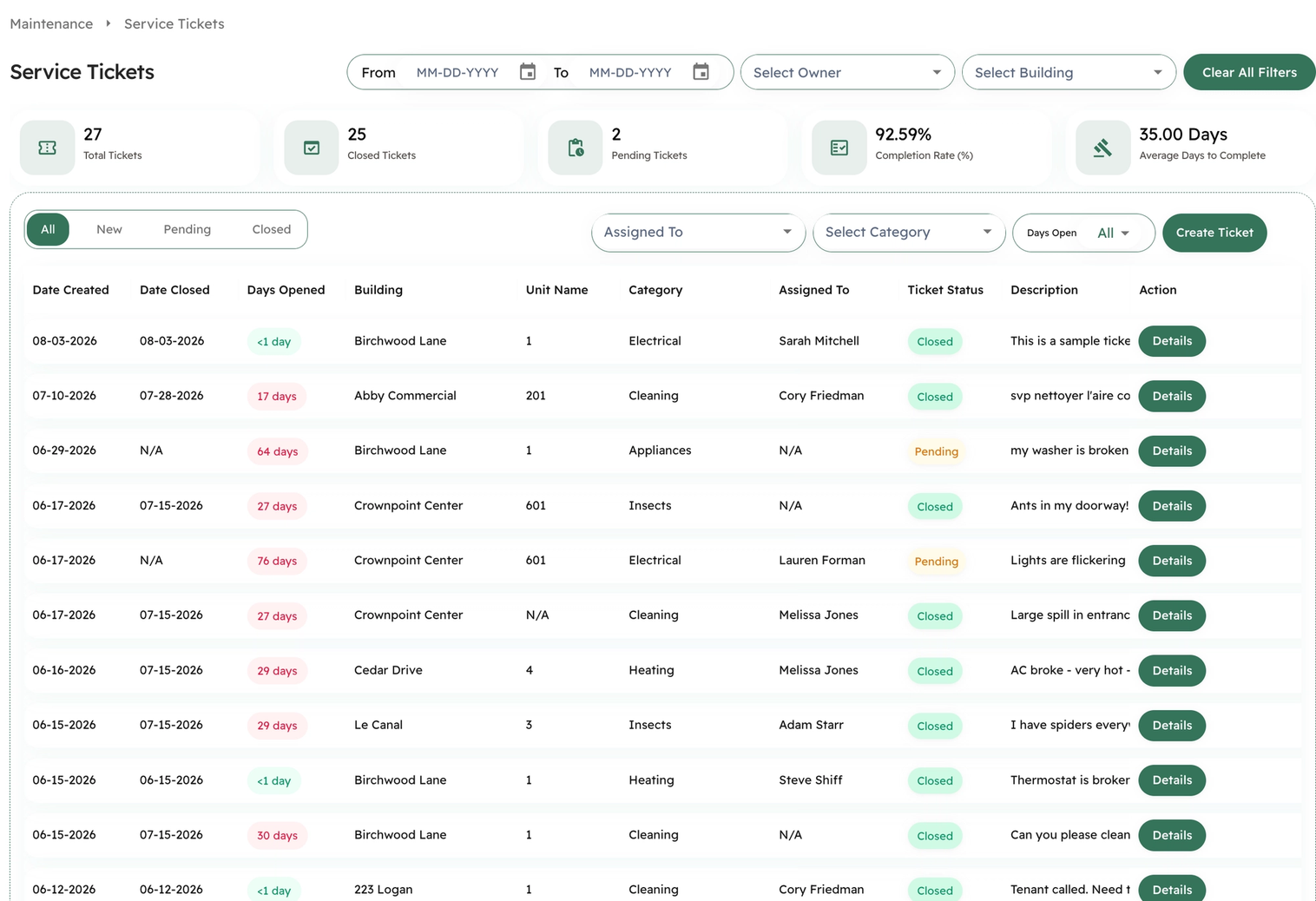
The On-Site Team

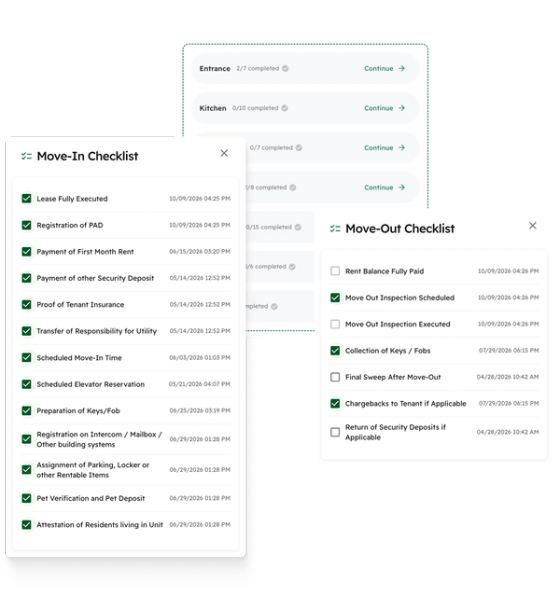
Unit Turnover
Never miss a turn with our integrated unit turnover dashboard that is directly integrated with our lease management system.
- Automated Creation of Tasks: Non renewals and new leases created in the system automatically create unit turnovers for you to manage.
- Move In-Out Checklists: Intuitive checklists for you to track all of the responsibilities you have for each turn.
- Event Scheduler: Schedule move in and move outs to ensure that you make the best first impression with your new tenants.

Move In-Out Inspections
Set a tenant up once and rent draws automatically, on the terms of their lease and renewals, with same- or next-day settlement. It's what powers First of Month: every tenant invoiced, every PAD drawn, every account filled, before you've lifted a finger.
- Mobile inspections: Inspections designed for mobile allow your on site team to input the results with pictures in real time.
- Report E-signature: Generate move in and move out inspection reports on the spot for e-signature with your tenants.
- Work Order Creation: Deficiencies from your inspection report will automatically create new work orders for your team to act on.

Preventative Maintenance
Buildings are like people. Each one unique - especially in terms of the equipment and recurring preventative maintenance that it requires
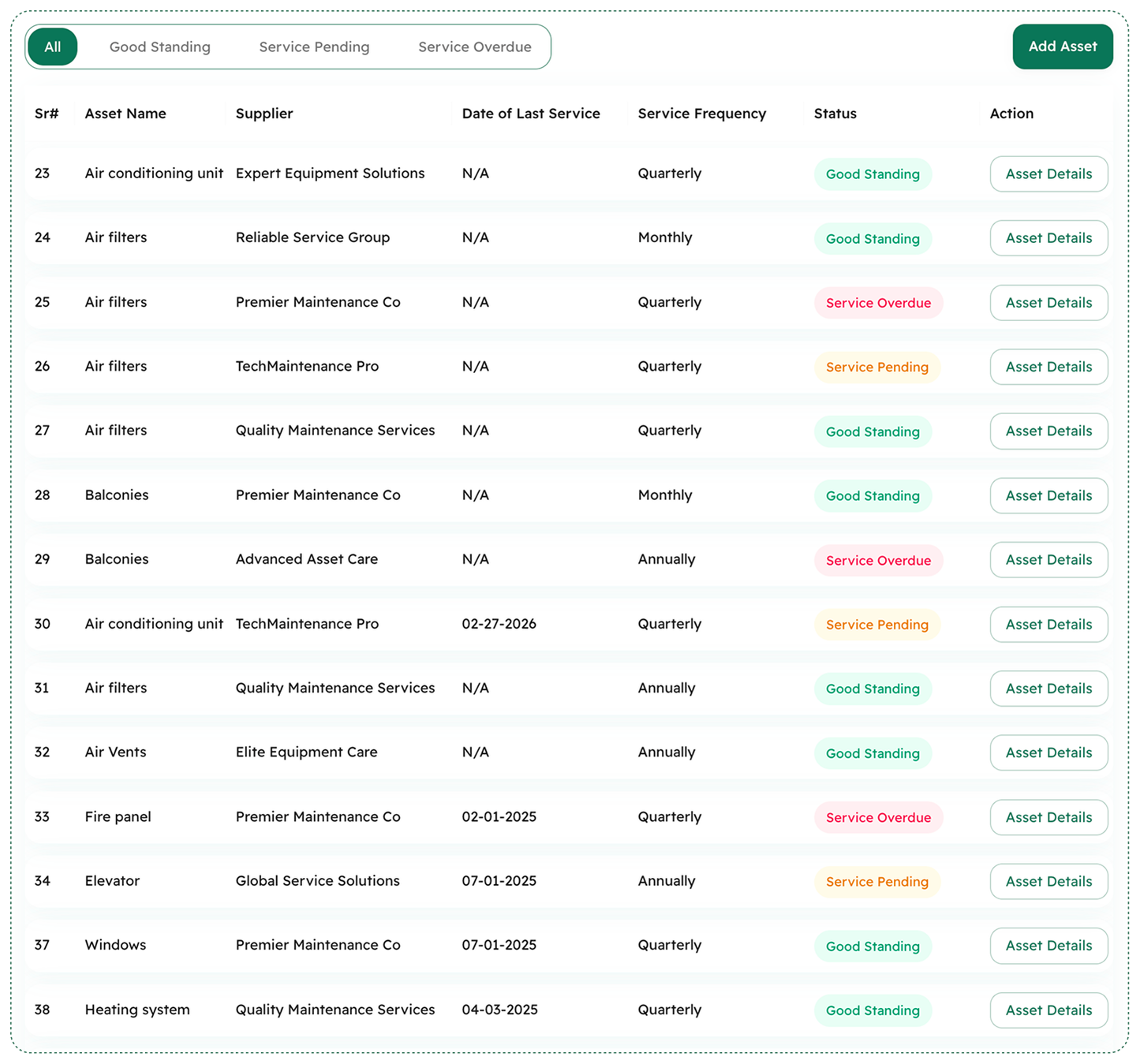
- Equipment Registration: Register all of the assets and equipment for each building so they can be shared across team members instead of in your property managers head.
- Recurring Service Reminders: Automate the task creation and reminders for recurring items like seasonal maintenance, contract renewals and more.
- Property Operations Manual: Generate a property operations manual that includes a list of service providers, service frequencies and equipments to service.


We migrated our 3,000-unit portfolio to Kompas and can't imagine going back. Rent collection is four business days faster, and we pay invoices without leaving the platform, automatically reconciled. Our leasing team now processes applications, background checks, and leases in one continuous flow, work that used to require three separate tools. Kompas will let us keep scaling with confidence.

Just started using Kompas and wow – I'm really impressed! The customer service is amazing – they listen, go out of their way to help, and make any special requests happen. The software is easy to navigate, and the team makes getting started a breeze. We're staying with this and see it as a great fit for the future of our growing business. I'd recommend it to other property management teams!

After nearly 10 years in property management, I've tried almost every PM software on the market. The major platforms aren't tailored to Quebec, and smaller ones can't handle real workflows. Kompas stands out because it's clearly built by real property managers and owners, covering every operational process without sacrificing accounting strength for ease of use. Their customer service is exceptional. I recommend Kompas to any landlord or management company.

We started using Kompas Management Company about a year ago, and the difference has been remarkable. Their software is tailor-made to handle both our tenant portal and accounting needs, and their team has customized the platform to fit us, not the other way around. Their customer service is always available and responsive. We recommend Kompas to any property management company looking for a partner, not just a vendor.

I've worked in property management for nearly 10 years and evaluated many software solutions. Most are strong in some areas but fall short in others; few understand both operations and accounting. Kompas stands out because it was built by people who understand the industry, covering day-to-day realities and the accounting we need. Their support is exceptional, and the team listens to feedback. I recommend Kompas to any property manager.

Kompas is a breath of fresh air for property management. Unlike clunky legacy software, it's incredibly intuitive and modern. The 'Lead-to-Lease' workflow and automated accounting are total game-changers for any team looking to scale. It's clearly built by people who understand the industry. Highly recommend!

Lauren was amazing to onboard us. Very happy we are working with Cory and the KOMPAS team!

Kompas has helped us bring greater structure and efficiency to our property management and accounting processes. The platform is intuitive, well adapted to the Quebec market, and lets us manage everything from invoices and payments to reconciliations in one place. The Kompas team is accessible, attentive to feedback, and genuinely committed to our success. I confidently recommend Kompas to other real estate owners and managers.

What property management and maintenance look like in one system
- Faster turnovers
- Units turnover on a plan, not whenever someone remembers.
- Accountability
- Every ticket has a clear owner and stays tracked until it’s resolved.
- Preventative, not reactive
- Recurring tasks fire on schedule, before something breaks.
- Protected NOI
- Deferred maintenance gets caught early, before it costs more.
- Costs post automatically
- Maintenance spend hits the ledger the moment it’s approved.
- One record per building
- Every request, turnover, and inspection lives in the same system.
- Built for the field
- Techs update, photograph, and close tickets from their phone.
- Scheduled inspections
- A move-out inspection can generate the work order itself.
Help Centre
Yes — we call them service tickets, and they run from a centralised dashboard where you manage, assign, track and comment on every maintenance task in the portfolio. Tickets are created either internally by your team or by tenants through the tenant portal, so a resident request and an inspection finding land in the same queue. This is the question we are asked most often about maintenance, and the answer is the dashboard rather than a shared inbox.
Yes — inbound service tickets can be assigned to named handymen or technicians on your team, who are notified that the ticket is theirs to complete. Assignment is what turns the dashboard from a list into a workload, since you can see who is carrying what before adding to anyone's queue. Assignment is limited to internal users; external contractors cannot be dispatched a ticket directly.
No — dispatch in Kompas goes to internal users only, so a work order cannot be sent to an external contractor the way it can to your own technician. If you use the same vendors regularly, the practical route is to create user accounts for them in the maintenance role, which costs nothing because seats are unlimited on every plan. It is a workaround rather than a vendor dispatch feature, and worth weighing if outsourced maintenance is your model.
Kompas tracks all of your move-ins and move-outs through checklists, scheduling and unit inspections, so a turnover is a defined process rather than a series of reminders. Move-in and move-out inspections are created automatically when a lease is executed or when a tenant gives notice, and the checklist carries the tasks that have to happen before the keys change hands. Renovation work planned as part of the turn is budgeted and measured in the same place.
Yes — Kompas has a unit inspection workflow designed to be used on mobile, so a move-in or move-out inspection is completed in the unit and produces an inspection report from there. The inspector is not filling a paper form and transcribing it at a desk afterward. The workflow needs a network or Wi-Fi connection to run, which is worth knowing before inspecting somewhere with no signal.
Yes — Kompas has a turnover analysis workflow where you itemize and budget renovation costs, compare the previous rent to projected market rent, and calculate an ROI on the work itself. That turns a renovation decision into a number rather than an instinct, and gives you something to show an owner asking why a unit sat empty for six weeks. The analysis lives with the turnover record rather than in a separate spreadsheet.
No — Kompas does not have time tracking today, so hours spent on a service ticket are not captured against it. This is a function we are actively working on to bring to the platform. If labour cost per ticket is central to how you price or bill work, it is worth raising early rather than assuming it can be approximated with what exists now.