

Kompas was built to be the best accounting software for property management, not an afterthought bolted onto another platform. It runs together with your operations, so every payment, lease, and work order updates your books.
Accounts Receivable
Accounts receivable, built the way your accountant would want it. Revenue is recognized on an accrual basis. Every lease has its own AR sub-ledger. Your aging ties to the GL, every time.
Invoicing runs on schedule.
Rent and recurring charges are billed and collected on the first, automatically.
Collections live in one view.
Every balance owing across the portfolio is in one place. Reminders go out to all of them at once.
Deposits stay on the balance sheet.
Security deposits are held as a liability and applied to rent when you decide.
Payments reconcile themselves.
PAD and Interac e-Transfer payments are matched to the right lease and posted as they land.

Accounts Payable
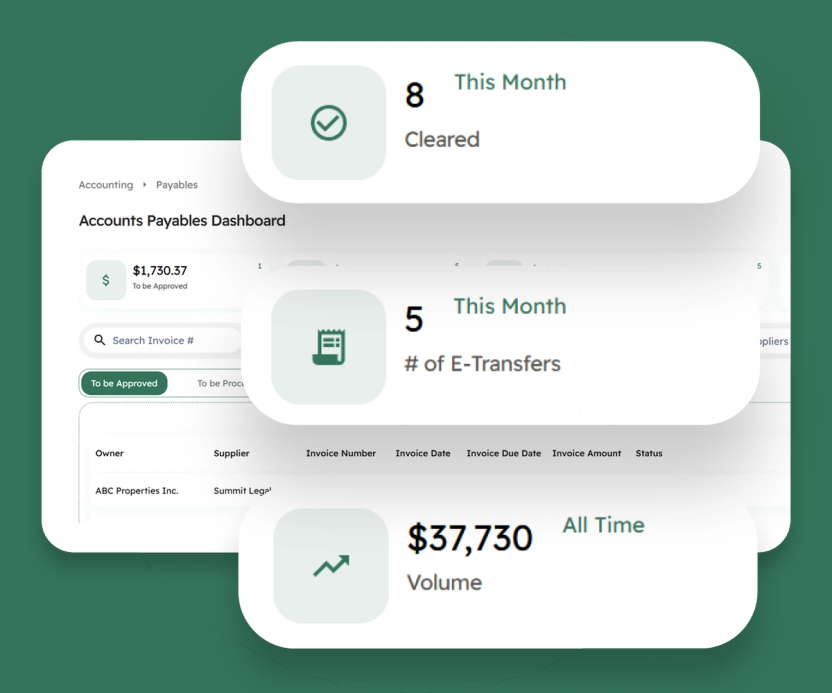
Approvals that match how your team actually works. From PO to disbursement, every payable reaches the right person at the right time.
- Invoice tagging: Split by unit or building the moment invoices arrive.
- PO matching & approvals: Multi-step rules keep you in control without becoming the bottleneck.
- Cheque printing: Pre-printed or blank stock, for suppliers still paid that way.
Banking & Reconciliation
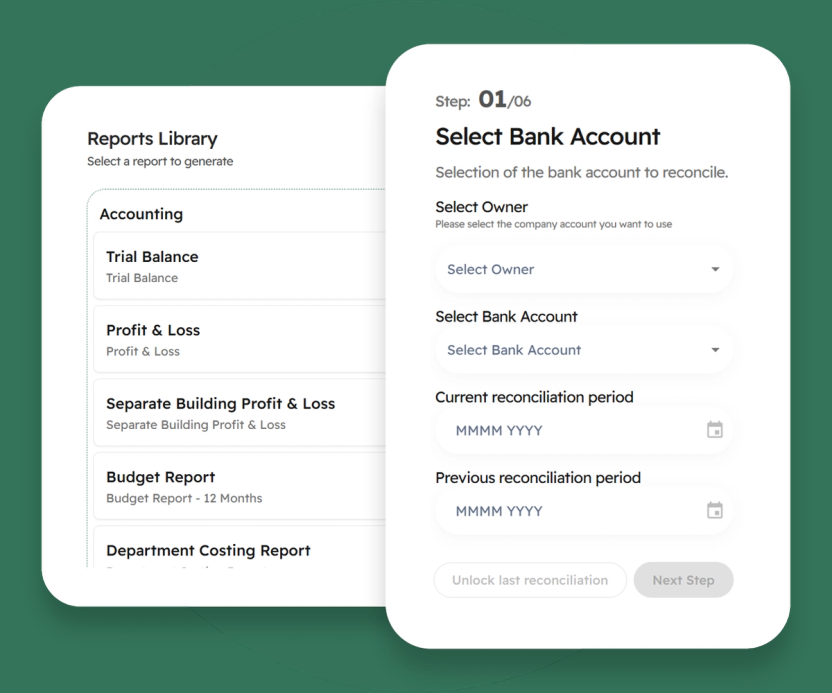
Reconciliation done the way your auditor expects. Every account ties to the GL, and once a period is closed, it stays closed.
- GL-mapped accounts: Every entity and bank account tied to the right GL account.
- Locked reconciliations: Audit-ready PDF reports with statements attached.
- Sales-tax reconciliation: GL backup and obligation summaries, monthly, quarterly, or annually.

Reporting
Reporting that fits your portfolio, not a template. Choose the filters, columns, and periods that matter, and save them for next time.
- Standard + real estate reporting: Trial balance through rent roll, plus building P&Ls and job costing.
- Full drill-down: Every report traces to the source transaction and audit trail.
- Scheduled delivery: Export to PDF or Excel, or set it to send automatically.
We migrated our 3,000-unit portfolio to Kompas and can't imagine going back. Rent collection is four business days faster, and we pay invoices without leaving the platform, automatically reconciled. Our leasing team now processes applications, background checks, and leases in one continuous flow, work that used to require three separate tools. Kompas will let us keep scaling with confidence.

Just started using Kompas and wow – I'm really impressed! The customer service is amazing – they listen, go out of their way to help, and make any special requests happen. The software is easy to navigate, and the team makes getting started a breeze. We're staying with this and see it as a great fit for the future of our growing business. I'd recommend it to other property management teams!

After nearly 10 years in property management, I've tried almost every PM software on the market. The major platforms aren't tailored to Quebec, and smaller ones can't handle real workflows. Kompas stands out because it's clearly built by real property managers and owners, covering every operational process without sacrificing accounting strength for ease of use. Their customer service is exceptional. I recommend Kompas to any landlord or management company.

We started using Kompas Management Company about a year ago, and the difference has been remarkable. Their software is tailor-made to handle both our tenant portal and accounting needs, and their team has customized the platform to fit us, not the other way around. Their customer service is always available and responsive. We recommend Kompas to any property management company looking for a partner, not just a vendor.

I've worked in property management for nearly 10 years and evaluated many software solutions. Most are strong in some areas but fall short in others; few understand both operations and accounting. Kompas stands out because it was built by people who understand the industry, covering day-to-day realities and the accounting we need. Their support is exceptional, and the team listens to feedback. I recommend Kompas to any property manager.

Kompas is a breath of fresh air for property management. Unlike clunky legacy software, it's incredibly intuitive and modern. The 'Lead-to-Lease' workflow and automated accounting are total game-changers for any team looking to scale. It's clearly built by people who understand the industry. Highly recommend!

Lauren was amazing to onboard us. Very happy we are working with Cory and the KOMPAS team!

Kompas has helped us bring greater structure and efficiency to our property management and accounting processes. The platform is intuitive, well adapted to the Quebec market, and lets us manage everything from invoices and payments to reconciliations in one place. The Kompas team is accessible, attentive to feedback, and genuinely committed to our success. I confidently recommend Kompas to other real estate owners and managers.

The switch to Kompas has saved myself and Lameer multiple hours each week on rent collection. As the person responsible for our entire e-transfer process, I used to spend hours mapping transfers and our admins spent hours entering deposits. With Kompas, I map an e-transfer once and A/R is instantly reflected, with zero admin or manager work needed. Excited to see what features are coming next!
Rooted in Canadian compliance, automated end-to-end
- GST
- Federal sales tax, calculated automatically
- PST
- Provincial sales tax, calculated automatically
- HST
- One harmonized rate, correct in every HST province.
- T776
- Statement of Real Estate Rentals, ready before year-end asks for it.
- TP-1086
- Québec rental income filing, done without the scramble.
- RL-31
- Québec’s tenant information slip, generated and ready to issue, automatically.
Help Centre
Accounting is the foundation of Kompas rather than a separate purchase bolted on beside it, so the general ledger sits underneath every lease, rent invoice, service ticket and vendor payment you process. When a lease is executed, its terms translate into the accounting system automatically for invoicing and receivable tracking. When a payable is approved and paid, the ledger and your bank position move in the same step. There is no export between a property management system and an accounting system, because there is only one set of books.
Yes — Kompas replaces the property management software plus separate accounting software setup most operators run, because rent collection, leasing, maintenance and financial reporting all post to the same general ledger. If you run Building Stack alongside QuickBooks today, Kompas removes the second system and the exports between them. Service tickets, rentable items, renewals and payments each carry their own GL coding, so your trial balance, profit and loss and rent roll come out of the platform rather than out of a workbook someone maintains by hand.
Your financial position updates as transactions post, so you do not wait for month-end to see where a property stands. Rent invoices post on the first of the month, payments made through the platform reconcile as of their settlement date, and approved payables hit the ledger as they are approved. Profit and loss, balance sheet and AR listings can be run at any point in the period, scoped to one building, one owner or the whole portfolio. Net operating income is read off the same live ledger rather than rebuilt afterwards.
No — all of the terms of the lease translate into the accounting system automatically on signature, for invoicing and receivable tracking. That is the practical payoff of one platform rather than two: the rent, the term, the inclusions and the charges you negotiated are the same record the first invoice is built from. Nobody retypes a lease into an accounting file, and there is no window where the two disagree.
Month-end close in Kompas is mostly review rather than data entry, because the transactions that make up the month are already posted. Leases invoice automatically on the first, platform-initiated payments reconcile as of their settlement date, and approved payables post to the default GL accounts you set per supplier. What is left is a bank reconciliation against the transactions Kompas did not initiate, recurring journal entries for items like bank fees, amortization and prepaid expense allocation, and then running your trial balance, profit and loss and balance sheet.
Yes — Kompas tracks every rent invoice issued to a tenant or group of tenants, allocates payments against those invoices, and keeps a running rent balance on each lease. Your accounts receivable dashboard reflects new charges, collected payments and failed payments as they post, so the balance in front of you is the current one. From there you can open a single tenant's invoice and payment history, or pull an aged AR listing for a building, an owner or the entire portfolio.
Kompas is built for organizations running several legal entities, so each entity carries its own sales tax numbers, invoice templates, sending email address and settings while your team works from one login. Sales tax follows the province: federal only, harmonized, or federal plus a provincial rate, which Quebec calls QST and other provinces call PST. Owners, buildings and portfolio segments report separately or consolidated, and the supplier list is shared across every entity, so a vendor added once can be invoiced and paid from any of them.